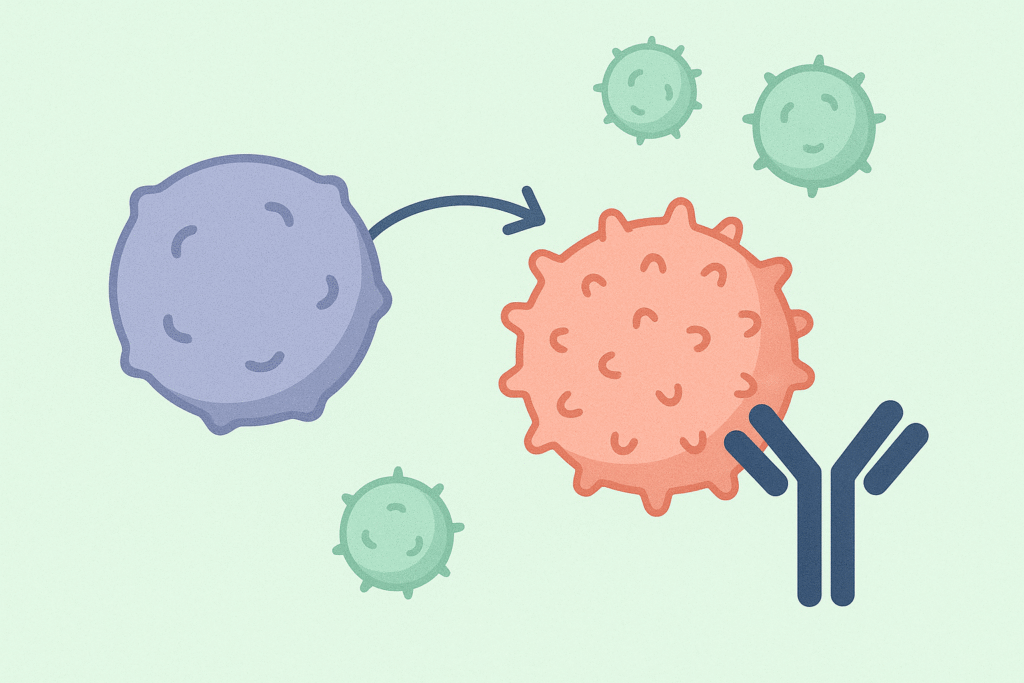
Among all the components of the immune system, T cells and B cells play the most central role. These two types of cells are responsible for adaptive immunity, which allows the body to recognize specific pathogens, remember them, and eliminate them with precision.
This article explains what T cells and B cells are, where they are produced, how they function, and what makes them different, in a clear and easy-to-understand way.
1. What Are T Cells and B Cells?
Adaptive immunity is the part of the immune system that can identify specific pathogens and respond more powerfully upon re-exposure.
At the heart of this system are T cells and B cells.
Both are types of lymphocytes, a major category of white blood cells. Their primary function is to recognize pathogens, eliminate them, and form immune memory for future protection.
2. T Cells: Where They Mature and What They Do
T cells originate in the bone marrow, just like other blood cells. However, after they are created, they migrate to the thymus, where they undergo a training process. During this process, T cells learn to distinguish the body’s own healthy cells from foreign invaders.
Main Functions of T Cells
-
Directly destroy infected or abnormal cells
-
Coordinate and regulate overall immune responses
-
Activate B cells to promote antibody production
-
Participate in the formation of immune memory
Major Types of T Cells
-
Helper T Cells
These cells act as the commanders of the immune system. They activate and regulate other immune cells. -
Cytotoxic (Killer) T Cells
These cells directly destroy virus-infected cells and cancer cells. -
Regulatory T Cells
These maintain immune balance by preventing excessive or misdirected immune responses. -
Memory T Cells
These retain information about past infections and enable rapid responses upon re-infection.
In short, T cells serve as both strategic controllers and frontline combat units of the immune system.
3. B Cells: Where They Mature and What They Do
B cells are produced and mature in the bone marrow. The letter “B” in B cells originates from “Bone Marrow.”
Unlike T cells, B cells do not usually destroy cells directly. Instead, their main role is to produce antibodies, which neutralize pathogens indirectly.
Main Functions of B Cells
-
Recognize specific pathogens
-
Produce antibodies
-
Differentiate into memory cells for future protection
When B cells are activated, they differentiate into plasma cells, which release large amounts of antibodies into the bloodstream.
Antibodies perform the following actions:
-
Neutralize pathogens directly
-
Mark pathogens so other immune cells can recognize them
-
Activate the complement system to enhance pathogen destruction
Some B cells become memory B cells, allowing the body to produce antibodies extremely rapidly upon future exposure to the same pathogen.
4. Key Differences Between T Cells and B Cells
| Category | T Cells | B Cells |
|---|---|---|
| Main Role | Destroy infected cells and coordinate immunity | Produce antibodies |
| Maturation Site | Thymus | Bone marrow |
| Mode of Action | Direct cell-to-cell killing | Indirect attack via antibodies |
| Type of Immunity | Cell-mediated immunity | Humoral immunity |
| Memory Formation | Memory T cells | Memory B cells |
Simply put:
T cells fight directly, while B cells fight by producing antibodies.
5. How T Cells and B Cells Work Together
-
A pathogen enters the body
-
Innate immunity provides the first response
-
Helper T cells analyze pathogen information
-
Helper T cells activate B cells
-
B cells differentiate into plasma cells and produce antibodies
-
Cytotoxic T cells destroy infected cells
-
Some T and B cells become memory cells for long-term protection
This entire sequence represents the core process of adaptive immune response.
6. The Relationship Between Vaccines and T & B Cells
Vaccines introduce a harmless form of an antigen into the body, allowing T cells and B cells to form immune memory in advance.
As a result:
-
The immune system is already prepared before real infection
-
Antibodies and immune responses are activated much faster
-
Severe illness is prevented
The effectiveness of vaccines depends directly on the memory functions of T cells and B cells.
7. Factors That Weaken T Cells and B Cells
-
Lack of sleep
-
Chronic stress
-
Protein and vitamin D deficiency
-
Aging
-
Chemotherapy and radiation therapy
-
Use of immunosuppressive drugs
-
Chronic diseases
When these conditions persist, susceptibility to infection increases and recovery becomes slower.
Conclusion
T cells and B cells are the true core of adaptive immunity.
T cells directly attack infected cells and coordinate the immune system, while B cells produce antibodies that neutralize pathogens and create immune memory.
The cooperation between these two types of cells is what allows our bodies to accurately recognize, remember, and eliminate countless viruses and bacteria every day.
Understanding how T cells and B cells work provides a deeper insight into how immunity, vaccines, and disease resistance function at a fundamental level.