A Motivation-Enhancing Strategy Applied Beyond Games
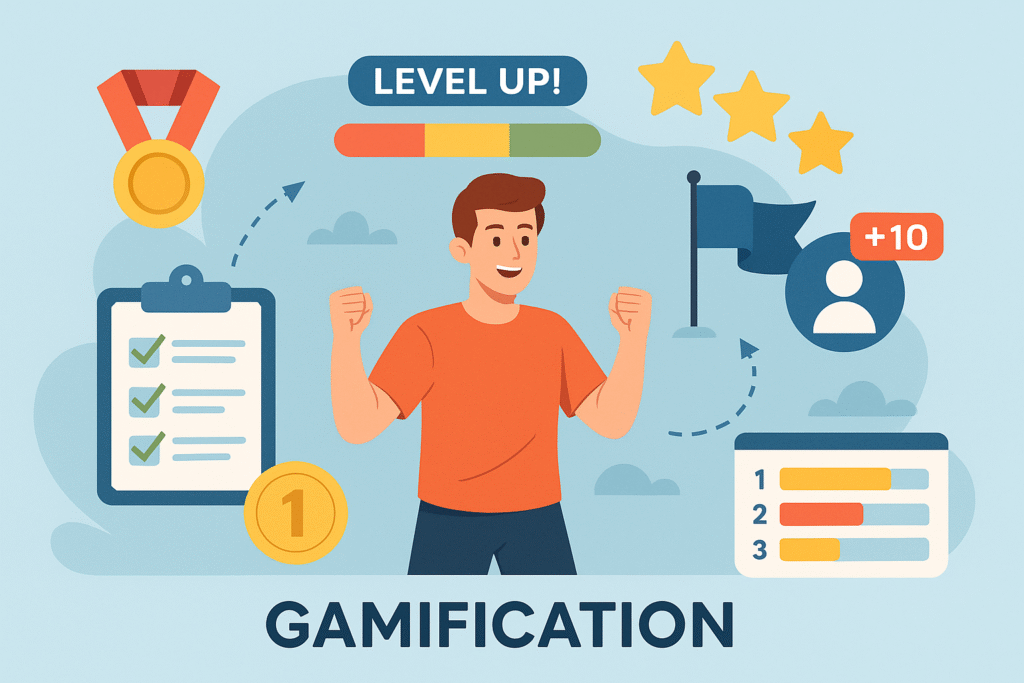
Gamification refers to the practice of applying game mechanics and design elements to non-game contexts in order to increase participation, engagement, and motivation. Elements such as points, levels, badges, quests, and leaderboards are used to encourage users to take action and maintain consistent behavior.
Humans inherently respond to rewards, achievement, and a sense of progress. Gamification leverages these psychological triggers to make users voluntarily engage even in tasks that might otherwise feel repetitive or uninteresting.
Core Elements of Gamification
1. Points and Reward Systems
Users earn points for performing certain actions, which can later be exchanged for rewards or used to track progress.
Points reinforce a sense of accomplishment and encourage repeated behaviors.
2. Levels and Growth Structure
As users achieve set milestones, they level up, creating a sense of growth and progression that keeps them motivated.
3. Badges or Achievement Titles
Badges are granted when users complete missions or achieve specific goals.
They serve as visible markers of success and are a key motivator in many systems.
4. Missions and Quests
Clear objectives help users understand what to do and why.
Short-term and long-term missions increase participation and engagement.
5. Leaderboards
Ranking users based on performance introduces healthy competition and drives people to challenge themselves.
6. Immediate Feedback
Providing instant responses or rewards—such as animations, sound effects, or pop-up messages—enhances the user experience and strengthens positive behavior.
Examples of Gamification in Practice
1. Education
Online learning platforms integrate point systems, streaks, and level-up mechanics to encourage students to continue learning.
Duolingo is a well-known example, increasing retention by awarding badges and tracking daily learning streaks.
2. Healthcare and Fitness Apps
Walking apps give users points for step goals, and fitness apps offer achievement badges for consistent workouts.
These features encourage users to be more active not only for health benefits but also to achieve goals within the app.
Samsung Health and Nike Run Club incorporate such gamified systems.
3. Corporate Training and Organizational Management
Companies apply gamification to internal training programs by adding levels or visualizing task completion rates.
This boosts employee engagement, promotes healthy competition, and can improve performance outcomes.
4. Shopping and Marketing
Shopping apps frequently use missions, attendance check-ins, bonus points, and reward coupons.
These gamified elements encourage frequent app visits and increase purchase behavior.
Examples include the attendance check features on Naver and Kakao, and mission-based point systems on Coupang.
5. App Services and Online Communities
Communities often allow users to level up based on activity or award badges for popular posts.
These systems foster active participation, user loyalty, and vibrant community interaction.
The Impact of Gamification
Gamification is not simply about adding fun; it is a strategy built upon psychological and behavioral principles.
It stimulates both intrinsic motivation (enjoyment, mastery, purpose) and extrinsic motivation (rewards, badges, status).
Through gamification, organizations and platforms can:
-
Reinforce repeated behaviors
-
Make unappealing tasks more engaging
-
Significantly increase user participation and retention
When designed well, gamification transforms ordinary services or activities into meaningful, enjoyable, and sustainable experiences.